 SOUTH AFRICAN PARENT’S GUIDE 2025/2026
ADHD, Comorbidities
& Your Money
Tax relief, medical aid benefits, and how to legitimately maximise your SARS rebate for ADHD and related conditions
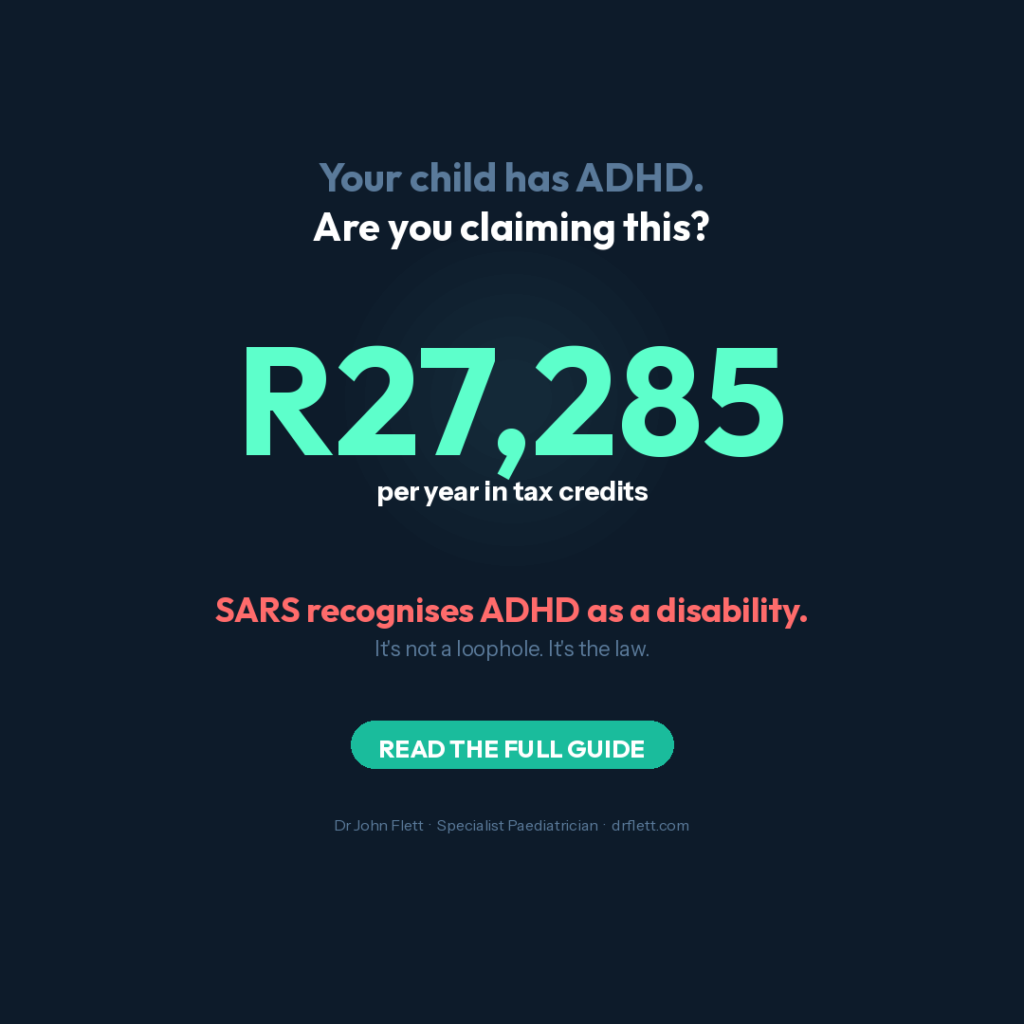
| 33.3% TAX CREDIT RATE | 10yr ITR-DD VALIDITY | R27k+ POTENTIAL SAVINGS |
Raising a child with ADHD in South Africa is expensive. Between specialist consultations, medication, occupational therapy, psychological assessments, and — for many families — specialised schooling, the costs add up fast. And when your child also has co-occurring conditions like anxiety, depression, learning disabilities, or sensory processing difficulties, the financial burden multiplies.
Here’s the good news: there are entirely legitimate ways to reclaim a meaningful portion of those expenses through the South African tax system and through strategic use of your medical aid. Most parents I work with are leaving money on the table — not because they’re careless, but because nobody has ever explained these benefits clearly.
■ Section 1ADHD as a “Disability” for Tax Purposes
I know the word “disability” can feel uncomfortable. Many parents resist it. But for tax purposes, it doesn’t mean what you think. SARS defines a disability as:
📋 SARS Definition of Disability — Section 6B(1)
| 🧠 Mental / Intellectual Including ADHD, anxiety, depression, bipolar mood disorder | 👁️ Sensory Visual, auditory, or sensory processing impairments | 🗣️ Communication Speech, language, and social communication difficulties | 📖 Functional Impact Moderate to severe limitation lasting 12+ months |
ADHD, by its very nature, moderately to severely limits a child’s ability to concentrate, organise, manage time, regulate emotions, and perform at school. When comorbidities are present — anxiety, depression, oppositional defiant behaviour, specific learning disabilities, autism spectrum traits — the case becomes even stronger.
💡 SARS explicitly recognises ADHD, anxiety disorders, bipolar mood disorder, depression, and epilepsy as qualifying disabilities when they meet the severity criteria. This is not a loophole. It is how the legislation is designed to work.
❌ Without ITR-DD25%Credit on expenses exceeding 7.5% of taxable income — a high threshold that’s hard to reach. Most families get little or nothing back. | ✅ With ITR-DD33.3%Credit on all qualifying expenses with no income threshold. Applies to your entire family’s medical costs, not just the child. |
The ITR-DD Form: Your Key Document
Everything starts with the ITR-DD (Confirmation of Diagnosis of Disability) form from SARS. This is the official document that confirms your child’s disability for tax purposes.
| 1 | You complete Part AFill in your and your child’s personal details as parent or guardian. |
| 2 | Your specialist completes Parts B, C & DA registered medical practitioner (paediatrician, psychiatrist, or clinical psychologist) confirms the diagnosis and its functional impact. |
| 3 | You keep the form safeDo not submit it with your tax return. SARS will only request it during an audit or inspection. Valid for 10 years for permanent conditions. |
💡 Practical tip: If your child has been diagnosed with ADHD by a specialist and you don’t yet have an ITR-DD form, contact your diagnosing practitioner. Many practitioners, including Dr Flett, are experienced in completing these forms accurately.
■ Section 3What Can You Actually Claim?
Once you have a valid ITR-DD form, the range of claimable expenses is broader than most parents realise.
| 🩺Specialist ConsultationsPaediatrician, psychiatrist, psychologist, and neurologist visits not covered by medical aid | 💊MedicationMethylphenidate, atomoxetine, and other prescribed ADHD and comorbidity medications | 🧩Therapy SessionsOccupational therapy, speech therapy, CBT, play therapy, and remedial sessions |
| 📝AssessmentsPsycho-educational, neuropsychological, and developmental assessments | 🏫Special Education FeesThe difference between special school fees and the nearest public school’s fees | 📚Tutoring & Extra LessonsPrivate tutoring supplementary to formal education, paid to professional providers |
| 🚗Travel CostsTransport to therapy, specialist appointments, and to obtain disability-related services | 💻Assistive TechnologyCommunication aids, adaptive learning devices, sensory tools, and specialised software | 👩⚕️Classroom FacilitatorsShadow teachers and in-class assistants required because of the disability |
How the Tax Credit Is Calculated
South Africa uses a tax credit system, which means the benefit reduces your actual tax payable — not your taxable income.
Medical Scheme Fees Tax Credit (MTC)
| Member | Monthly Credit (2025/26) |
|---|---|
| Main member | R364 |
| First dependant | R364 |
| Each additional dependant | R246 |
Additional Medical Expenses Tax Credit (AMTC)
With a valid ITR-DD: 33.3% of all qualifying out-of-pocket medical and disability expenses, plus 33.3% of medical aid contributions exceeding three times your annual MTC. No income threshold.
📊 Worked Example: Family with One Child with ADHD
| Monthly medical aid contributions | R3,500 |
| Annual medical contributions | R42,000 |
| Annual MTC (2 members + 1 additional) | R11,688 |
| Excess contributions (R42,000 − 3 × R11,688) | R6,936 |
| Unrecouped medical expenses | R45,000 |
| Special education fee difference | R30,000 |
| Total qualifying amount | R81,936 |
Medical Aid: Getting the Most from Your Scheme
ADHD is not a Prescribed Minimum Benefit (PMB) condition, nor on the Chronic Disease List (CDL). Medical aids aren’t legally required to cover it. However, many schemes voluntarily include ADHD on their Additional Disease List (ADL).
| 💊Register as ChronicApply for chronic medication benefits early. Submit diagnosis and clinical documentation. | 📋Check Your FormularyGeneric medications often have lower co-payments. Ask about formulary options. | 🧠Mental Health BenefitsCheck how many psychology and psychiatry sessions are covered annually. | 🔄Comorbidity AdvantageDepression and epilepsy are on the CDL. Register co-occurring PMB conditions. |
💡 If your specialist charges above your scheme’s rate, gap cover insurance can bridge the difference — particularly valuable for paediatric specialist consultations and psychological assessments.
■ Section 6Special Education: What’s Claimable
This is perhaps the most misunderstood area — and potentially the most valuable.
The Fee Difference Calculation
| R15k Nearest Public School | R85k Special Needs School |
If your child remains in mainstream education but requires additional support — classroom facilitators, extra lessons, remedial sessions, or specialised learning materials — those additional costs incurred as a direct result of the disability are also claimable.
■ Section 7Your Step-by-Step Action Plan
| 1 | Get the ITR-DD form completedContact your child’s diagnosing specialist. Valid for 10 years for permanent conditions. |
| 2 | Register ADHD as a chronic condition with your medical aidSubmit clinical documentation and apply for chronic medication benefits. |
| 3 | Keep every receipt and invoiceCreate a dedicated file for all ADHD-related expenses: consultations, therapy, medication, assessments, school fees, tutoring, travel. |
| 4 | Collect your medical scheme tax certificateIssued annually by your scheme, showing contributions paid and amounts not covered. |
| 5 | Declare all qualifying expenses on your ITR12Use source code 4020 for medical certificate expenses, 4034 for out-of-pocket, and 4116 for disability-specific expenses. |
| 6 | Consider retrospective claimsSARS allows reassessment of previous tax years if you’ve been paying without claiming. |
| 7 | Use a disability tax specialistAn experienced practitioner can identify overlooked expenses and ensure your claim is robust. |
Documents You Must Keep
SARS requires supporting documentation for at least five years:
| ✅ Completed and signed ITR-DD form |
| ✅ Annual medical scheme tax certificate |
| ✅ All out-of-pocket medical invoices & receipts |
| ✅ School fee statements (special + reference public) |
| ✅ Therapy & tutoring invoices with service descriptions |
| ✅ Travel logs (dates, distances, purpose) |
| ✅ Clinical reports & assessment results |
The Bottom Line
You are already spending this money. The tax system provides legitimate, meaningful relief for families managing ADHD and its comorbidities. The ITR-DD form is the single most important step you can take.
Your child’s ADHD is not going away.
Neither should your right to claim back what the law allows.
Need Help Getting Started?
If you need an ITR-DD form completed, or would like guidance on your child’s diagnosis and treatment plan, get in touch.
📞 031 1000 474
8 Village Road, Kloof, Durban
drflett.com | Remote consultations available via Zoom